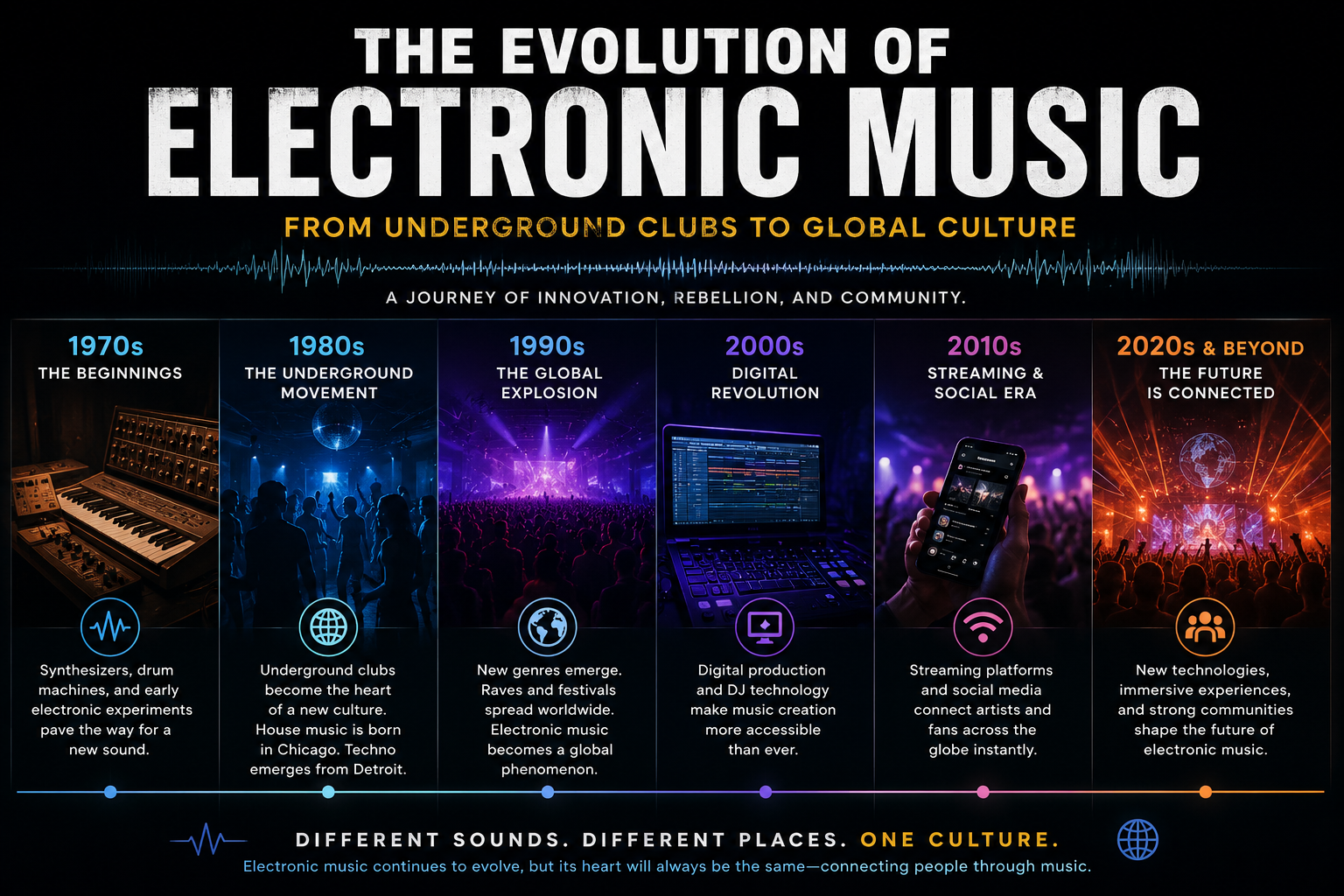
The evolution of electronic music has never been just about beats and basslines. It’s a story of innovation, rebellion, creativity, and community. What began as an underground movement in warehouses and small clubs has grown into one of the world’s most influential musical cultures. Today, electronic music fills stadiums, shapes popular music, inspires fashion, and connects millions of people across continents.
Whether you’re discovering house music for the first time or have spent years dancing until sunrise, understanding the journey of electronic music helps you appreciate why it continues to evolve.
The Birth of Electronic Music
Electronic music didn’t begin in massive festivals or luxury nightclubs. Its roots stretch back to the early 20th century when musicians started experimenting with electronic instruments and synthesized sounds.
The real turning point came during the 1970s and early 1980s. Advances in synthesizers, drum machines, and sequencers gave artists entirely new ways to create music that couldn’t be produced with traditional instruments.
Machines like the Roland TR-808, TR-909, and TB-303 became legendary—not because they were designed to change music, but because artists used them in unexpected ways.
The Underground Movement
Electronic music truly found its identity in underground clubs.
Cities like Chicago, Detroit, New York, Berlin, Manchester, and London became creative hubs where DJs and producers pushed musical boundaries.
These spaces weren’t just venues—they were communities.
People gathered regardless of background, culture, or profession, united by one thing: music.
Unlike mainstream concerts, the DJ wasn’t always the center of attention. The dancefloor became the focus, encouraging collective experiences rather than individual performances.
The Birth of House Music
House music emerged in Chicago during the early 1980s.
Inspired by disco, soul, funk, and electronic experimentation, DJs began extending dance records and creating hypnotic rhythms that kept people moving all night.
House music introduced:
- Four-on-the-floor drum patterns
- Deep basslines
- Soulful vocals
- Repetitive grooves
- Long, evolving arrangements
What started inside small clubs quickly spread worldwide.
Today, house music continues to influence countless genres and remains one of the foundations of electronic music culture.
Detroit and the Rise of Techno
While Chicago was developing house music, Detroit was creating something entirely different.
Techno combined futuristic sounds, industrial influences, and mechanical precision to create music that felt both emotional and machine-driven.
Artists experimented with:
- Synthesizers
- Drum machines
- Minimal melodies
- Repetitive structures
- Atmospheric textures
Berlin later embraced techno, transforming abandoned warehouses into legendary clubs that helped shape modern electronic music culture.
The Global Explosion
During the 1990s and early 2000s, electronic music expanded far beyond underground clubs.
New genres emerged rapidly:
- Trance
- Progressive House
- Drum & Bass
- Breakbeat
- UK Garage
- Electro
- Minimal
- Dubstep
- Electro House
Festivals grew larger every year, introducing electronic music to audiences around the world.
At the same time, independent labels continued supporting underground artists, ensuring that experimentation never disappeared.
Technology Changed Everything
The digital revolution transformed how electronic music was created.
Affordable software made professional music production accessible to almost anyone.
Today, producers can create complete tracks using:
- Ableton Live
- FL Studio
- Logic Pro
- Cubase
- Bitwig Studio
Similarly, DJs no longer rely exclusively on vinyl records.
Modern performances often use:
- USB drives
- Digital controllers
- CDJs
- Hybrid live setups
- Modular synthesizers
Technology lowered the barrier to entry while opening endless creative possibilities.
Streaming and Social Media
Platforms like YouTube, SoundCloud, Mixcloud, Spotify, Instagram, and TikTok completely changed how music is discovered.
An independent artist can now release music to a global audience without signing to a major label.
Livestreams, podcasts, and recorded DJ sets have also become important ways for artists to connect with listeners beyond physical events.
Music communities now exist both online and offline.
Why Underground Culture Still Matters
Even as electronic music has become more commercial, underground culture remains its heartbeat.
Independent venues and collectives continue to champion creativity over popularity.
These spaces encourage:
- Musical experimentation
- Long-form DJ sets
- New artists
- Diverse sounds
- Authentic communities
Many of today’s biggest artists began their journey playing intimate underground events before reaching larger stages.
Electronic Music Is More Than Entertainment
For many people, electronic music represents:
- Freedom of expression
- Creativity
- Community
- Cultural diversity
- Emotional connection
Unlike many genres built around lyrics, electronic music often communicates through rhythm, atmosphere, and energy.
Every DJ set tells a story without saying a single word.
The Rise of Community-Driven Platforms
One of the most exciting developments in recent years has been the growth of independent music communities.
Rather than focusing only on large festivals, these platforms create intimate experiences where artists and audiences connect more naturally.
They support:
- Emerging DJs
- Independent producers
- Creative collaborations
- Educational content
- Local music scenes
These communities play a vital role in keeping electronic music diverse, inclusive, and constantly evolving.
The Future of Electronic Music
Electronic music continues to evolve every year.
Artificial intelligence, immersive visual experiences, spatial audio, and virtual performances are changing how music is created and experienced.
At the same time, listeners are increasingly seeking authentic, community-driven experiences rather than simply attending large events.
The future isn’t just bigger festivals—it’s stronger communities, deeper connections, and more opportunities for independent artists to share their sound.
The Evolution of Electronic Music Continues to Inspire Millions
Electronic music has survived decades of changing trends because it constantly reinvents itself.
New genres emerge.
Old sounds return.
Technology evolves.
Artists experiment.
Communities grow.
Yet the core remains the same: bringing people together through music.
Whether you’re dancing in a packed warehouse, listening to a late-night mix at home, or discovering your favorite artist online, you’re participating in a culture that has spent decades connecting people across borders and generations.
Final Thoughts
From underground clubs in Chicago and Detroit to global festivals and online broadcasts, electronic music has transformed into one of the world’s most dynamic cultural movements.
Its journey is defined by innovation, collaboration, and a relentless desire to push creative boundaries. While technology continues to shape how music is made and shared, the essence of electronic music remains unchanged: creating moments that bring people together.
At Subcultural Music, we celebrate that spirit every day. Through curated broadcasts, community events, and platforms like THE ISLAND, we aim to support artists, showcase diverse sounds, and contribute to the ever-evolving culture of electronic music.
Because electronic music isn’t just something you hear—it’s something you experience.
Frequently Asked Questions
What is electronic music?
Electronic music is a broad genre created using electronic instruments, synthesizers, drum machines, and digital production software. It includes styles such as house, techno, drum & bass, trance, and many more.
Where did electronic music originate?
Modern electronic music culture developed primarily in Chicago and Detroit during the 1980s, where house and techno emerged before spreading worldwide.
Why is underground electronic music important?
Underground scenes encourage artistic freedom, support emerging talent, and preserve the creative roots of electronic music away from commercial pressures.
What is the difference between house and techno?
House music often features soulful grooves and warmer rhythms, while techno focuses on repetitive, futuristic sounds with a more mechanical feel.
How can I get involved in the electronic music community?
Attend local events, support independent artists, explore different genres, join music communities, and engage with platforms that promote emerging talent and underground culture.