What Is Electronic Music?
Electronic music is one of the most diverse and influential forms of music in the world today. From underground warehouse parties and intimate club nights to massive festivals and streaming playlists, its sound has reached every corner of the globe.
But if you’re new to the scene, you might be wondering: what exactly is electronic music?
Despite the name, electronic music isn’t a single genre. It’s an umbrella term that includes hundreds of styles, each with its own identity, culture, and sound. Whether it’s the soulful grooves of House, the hypnotic rhythms of Techno, the energy of Drum & Bass, or the bass-heavy swing of UK Garage, they’re all part of the same electronic music family.
In this guide, we’ll explore what electronic music is, how it began, the genres you’ll encounter, and why it continues to shape modern music culture.
The Definition of Electronic Music
Electronic music is music created using electronic instruments, digital technology, synthesizers, drum machines, samplers, and computer software.
Unlike traditional music, which relies primarily on acoustic instruments such as guitars, pianos, or drums, electronic music allows producers to create entirely new sounds that wouldn’t exist naturally.
Modern producers use software like Ableton Live, FL Studio, Logic Pro, and other digital audio workstations (DAWs) to compose, arrange, and produce tracks. These tools make it possible to design everything from deep basslines and atmospheric pads to complex rhythms and futuristic soundscapes.
However, electronic music isn’t defined solely by the equipment used—it’s defined by creativity. The technology simply becomes another instrument.
A Brief History of Electronic Music
Electronic music has been evolving for over a century.
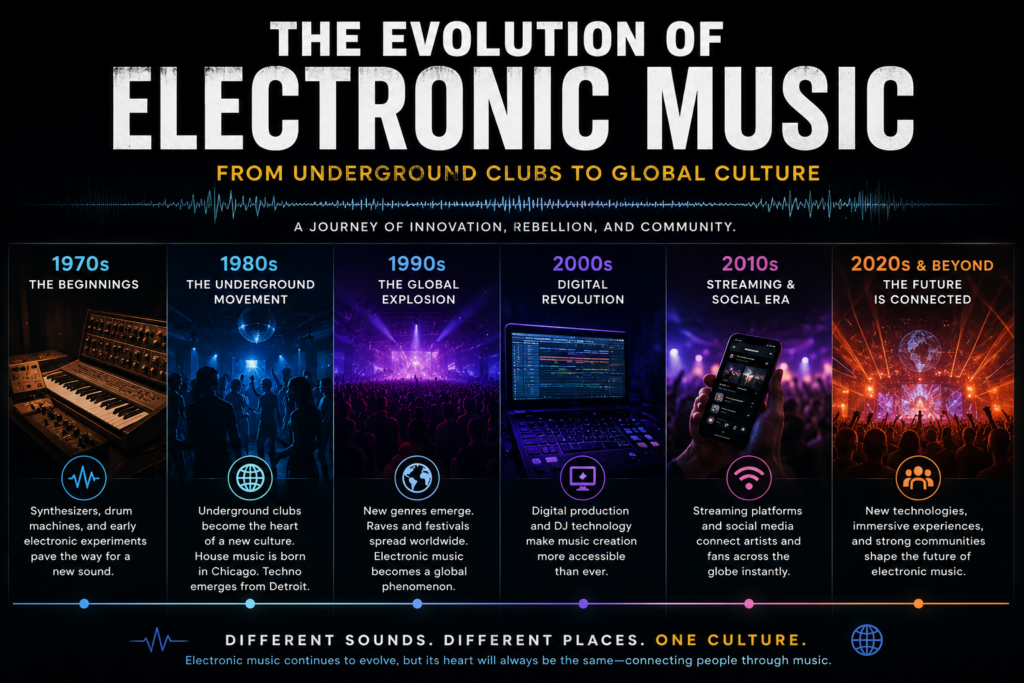
Early experiments with electronic sound began in the early 1900s, but it wasn’t until the 1970s and 1980s that electronic music truly found its identity.
Innovations like synthesizers, drum machines, and sequencers transformed music production. Instruments such as the Roland TR-808 and TR-909 became legendary, laying the foundation for countless genres that followed.
During the 1980s, cities like Chicago and Detroit became the birthplace of House and Techno. These underground movements eventually spread across Europe, the UK, and the rest of the world, influencing artists far beyond dance music.
Today, electronic music spans everything from underground club culture to film scores, pop productions, gaming, fashion, and live performances.
Popular Genres of Electronic Music
One of the biggest misconceptions is that electronic music is just “EDM.”
In reality, electronic music consists of hundreds of unique genres.
Some of the most well-known include:
House
House music is known for its warm grooves, soulful rhythms, and steady four-on-the-floor beat. It’s one of the most welcoming genres for new listeners and remains a cornerstone of club culture.
Techno
Techno focuses on hypnotic repetition, deep textures, and driving rhythms. Originating in Detroit, it has become one of the defining sounds of underground electronic music.
Melodic House & Techno
Blending emotional melodies with deep electronic rhythms, this genre creates immersive musical journeys that have become increasingly popular worldwide.
UK Garage
Characterized by shuffled drum patterns, syncopated rhythms, and heavy basslines, UK Garage has experienced a major resurgence in recent years.
Drum & Bass
Fast-paced, energetic, and bass-driven, Drum & Bass typically runs around 170–175 BPM and continues to thrive through festivals, clubs, and underground events.
Breakbeat & Breaks
Unlike the straight kick patterns found in House music, Breakbeat relies on broken rhythms and dynamic percussion, creating a more unpredictable groove.
Disco House
Combining classic disco samples with modern production techniques, Disco House delivers feel-good energy that’s perfect for dance floors.
These genres are only the beginning. Electronic music continues to evolve, with new sounds emerging every year.
Electronic Music vs EDM
Although many people use the terms interchangeably, electronic music and EDM (Electronic Dance Music) are not the same.
Electronic music refers to the entire spectrum of music created using electronic production techniques.
EDM, on the other hand, generally refers to commercially popular festival-oriented styles that emphasize dramatic builds, drops, and high-energy performances.
In other words:
Electronic Music = The entire universe.
EDM = One part of that universe.
This distinction helps explain why underground electronic communities often prefer describing themselves simply as electronic music fans rather than EDM fans.
Why Electronic Music Is More Than Just Music
Electronic music has always been closely connected to culture.
Around the world, it has helped create communities where people gather to share experiences through music, creativity, and self-expression.
Unlike many genres that focus primarily on the artist, electronic music often places equal importance on the dance floor, the atmosphere, the sound system, and the collective experience.
That’s why many people describe electronic music events as something you feel rather than simply listen to.
How DJs Fit Into Electronic Music
DJs play a unique role within electronic music culture.
Rather than performing songs one after another, they carefully blend tracks together to create a continuous musical journey.
A well-crafted DJ set considers:
- Energy progression
- Track selection
- Harmonic mixing
- Crowd interaction
- Atmosphere
- Storytelling through music
Every performance becomes a unique experience that can never be perfectly repeated.
Why Electronic Music Continues to Grow
Electronic music has become one of the fastest-growing forms of music worldwide because it constantly evolves.
New technology enables producers to experiment with fresh sounds, while communities continue discovering and creating entirely new genres.
Streaming platforms, independent labels, underground collectives, and local events have also made electronic music more accessible than ever before.
Whether you’re listening at home, attending an intimate venue, or dancing until sunrise, electronic music offers something for every listener.
How to Start Exploring Electronic Music
If you’re completely new to electronic music, start with curiosity rather than trying to understand every genre immediately.
Explore different styles, discover new artists, and pay attention to how each genre makes you feel.
You might enjoy the uplifting grooves of House, the hypnotic energy of Techno, the rolling basslines of UK Garage, or the fast-paced rhythms of Drum & Bass. There is no “right” place to begin.
The beauty of electronic music lies in its diversity.
Final Thoughts
Electronic music is far more than synthesizers, clubs, or festivals. It’s a global culture built around creativity, innovation, and connection.
With countless genres, artists, and communities to explore, every listener discovers their own path into the music.
Whether you’re stepping onto your first dance floor, discovering underground sounds online, or simply expanding your musical taste, electronic music offers a world of experiences waiting to be explored.
And once you dive in, you’ll quickly realise there’s always another sound, another artist, and another community waiting just around the corner.
FAQs
What are the main genres of electronic music today?
Electronic music includes genres like house, techno, and drum & bass.