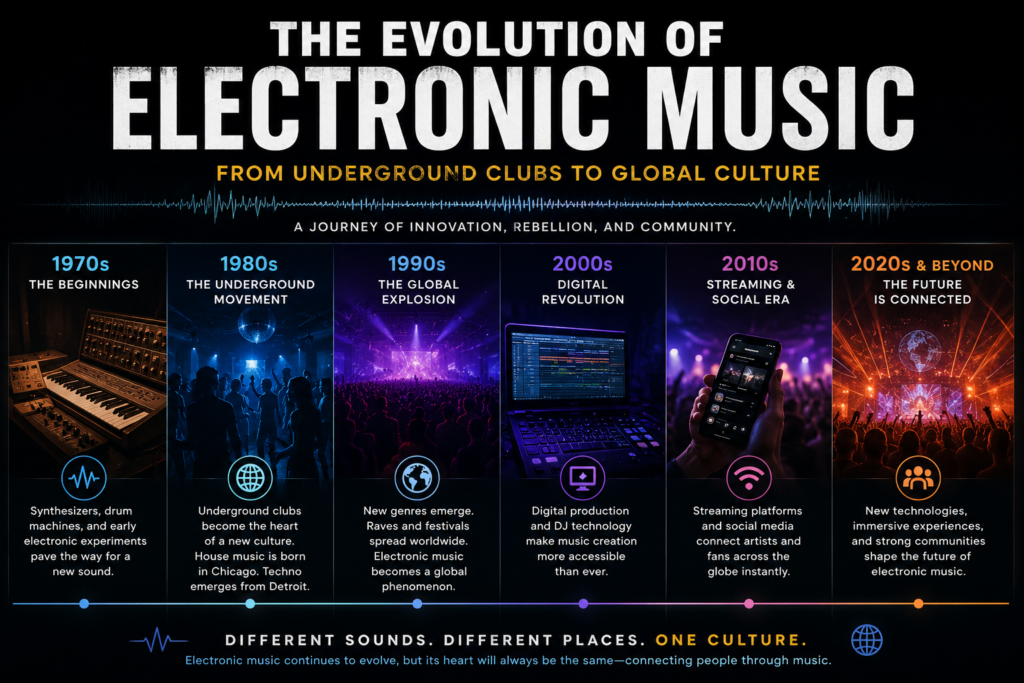

Consider this your electronic music subgenres explainer: there’s no single reason a genre that started with maybe three names — house, techno, and electro — has splintered into hundreds of micro-labels, from “melodic dubstep” to “UK bassline” to “hardgroove techno.” It’s a mix of cheap tools, DJ practicality, tribal identity, and, more recently, an algorithm that rewards specificity.
The Short Answer
Electronic music subgenres multiply for the same reason biological species do: isolation plus mutation. Small scenes develop in relative isolation from each other — a warehouse in Chicago, a club in Berlin, a pirate radio station in London — and each one mutates the same basic tools (drum machines, samplers, synthesizers) into something locally specific. Once a scene’s sound is distinct enough, it needs a distinct enough name, and a new subgenre is born.
Cheap Tools, Endless Combinations
Unlike a rock band, which needs a drummer, a bassist, a guitarist, and a room to rehearse in, electronic music has never needed more than one person and a relatively small pile of gear. That barrier dropped further with every decade — the Roland TR-808 and TB-303 that built house and acid house cost a few hundred dollars used by the late 1980s, and today a laptop with a modest DAW can build a track that would have needed a professional studio thirty years ago. When the cost of experimentation approaches zero, people experiment constantly, and almost every new combination of tempo, drum pattern, and bassline becomes a candidate for its own name.
The Dancefloor Needs Different Tools for Different Moments
A lot of subgenre splitting isn’t about ego — it’s function. A club night runs through distinct phases: a slow warm-up, a peak-time push, an afterhours comedown. Those phases genuinely need different music, at different tempos and different intensities, and DJs and producers have spent forty years naming the tools for each moment: deep house for warm-up, peak-time techno for the 1 a.m. rush, ambient and downtempo for the comedown. The more specific the function, the more specific the electronic music subgenre name tends to get.
Scenes Want Their Own Names
Naming a subgenre is also a way of drawing a line around a community — of saying this is ours, distinct from the genre it grew out of. UK garage split into 2-step and speed garage partly along regional and stylistic lines; drum & bass split into liquid, neurofunk, and jump-up as different UK cities and crews built distinct identities around the same 170 BPM breakbeat. New York’s Paradise Garage alone is credited with seeding an entire vocabulary of “garage” subgenre names that still get argued about today. A subgenre name is partly a sound and partly a flag.
Streaming Platforms Made It Worse (Or Better)
The last twenty years added a new pressure entirely: algorithmic curation. Streaming platforms build hyper-specific microgenre and mood tags to power recommendation engines, and those tags feed back into how artists and labels describe their own music — sometimes inventing labels for sounds that existed for years without one, sometimes genuinely capturing something new. Whether that’s diluting the culture or just giving long-existing electronic music subgenres names they always deserved depends entirely on who you ask.
Is This a Problem?
Not really, and most people inside the culture would say the opposite. A huge vocabulary of electronic music subgenres means more precision, not more confusion — “I’m into liquid drum & bass” tells a fellow fan something specific that “I like electronic music” doesn’t. The confusion mostly shows up at the edges, for newcomers trying to learn what separates house from techno from trance in the first place — which is exactly why guides like that exist.
Frequently Asked Questions
Quick answers to the questions this piece raises most often.
What’s the difference between a genre and a subgenre in electronic music?
A genre (house, techno, drum & bass) describes a broad, foundational sound and its history. A subgenre (deep house, minimal techno, liquid drum & bass) describes a more specific variation within that genre, usually tied to a particular tempo range, mood, or scene.
How many electronic music subgenres are there?
Nobody agrees on an exact number, but genre-tracking sites and streaming platforms have documented several hundred, and new ones get named every year as tools and scenes keep evolving.
Why do subgenre names keep changing?
Because the culture that names them is still active. As new tools, scenes, and DJ practices emerge, people need new vocabulary to describe them — a subgenre name is really just a snapshot of a moving target.
Is having so many subgenres a bad thing?
Most people in the scene see it as a feature, not a bug — more subgenres means more precision when describing what you actually like or want to hear, not less clarity.
Do streaming platforms create subgenres or just document them?
Both. Some platform-generated microgenre tags describe sounds that already existed without a widely used name; others are closer to marketing categories invented to help a recommendation algorithm sort tracks.
What’s the fastest way to learn the difference between subgenres?
Start with the major genres — house, techno, trance, drum & bass — and their tempos and origins, then branch into subgenres once you can already tell the big categories apart by ear.
Are subgenre names used differently in different countries?
Yes. A term like “garage” means something different in the UK (a bass-heavy, syncopated sound) than “garage house” does in the US (a soulful, vocal-driven house style descended from New York’s Paradise Garage).
Do DJs actually think about subgenres when building a set?
Constantly, even if they don’t say the names out loud. Choosing which subgenre to reach for at a given moment — deep house early, peak-time techno later — is a big part of what makes a set feel intentional rather than random.
By The DJs. For The DJs.
Subcultural Music — subculturalmusic.com