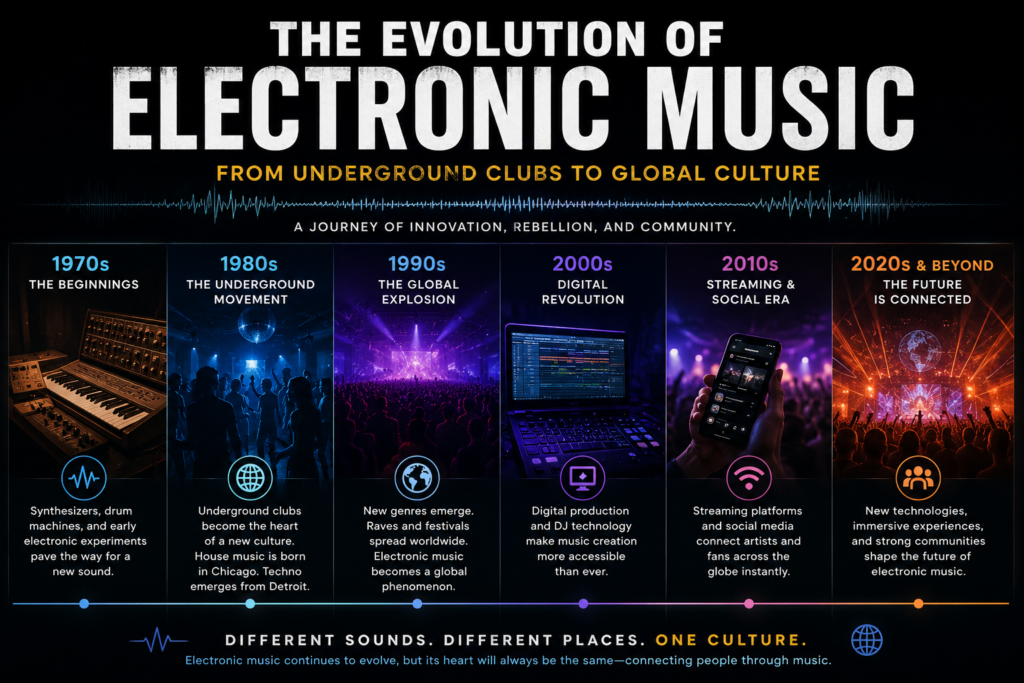

House and techno didn’t stay confined to the cities that invented them. Wherever electronic music scenes have taken root, they’ve picked up a different accent — different tempos, different rooms, different reasons people show up. Here are seven scenes worth knowing, and what actually makes each one distinct.
Chicago and Detroit: Where It Started
Known for: house and techno, born in the early-to-mid 1980s.
Chicago’s house scene grew out of DJs like Frankie Knuckles reworking disco records at the Warehouse club, while Detroit’s “Belleville Three” — Juan Atkins, Derrick May, Kevin Saunderson — built techno by fusing that same house DNA with Kraftwerk’s synth-pop starkness. Both cities’ original venues were unglamorous by design — cheap warehouse space, minimal production — and both electronic music scenes still run largely on that same DIY infrastructure today, even as the genres they invented have gone fully global.
Berlin: The Techno Capital
Known for: marathon techno sets, industrial venues, notoriously strict door policies.
Berlin inherited techno from Detroit in the early 1990s, right as the Berlin Wall came down and a wave of abandoned East German buildings became instant, rent-free club space. Clubs like Berghain (housed in a former power station) turned that raw industrial aesthetic into a defining feature rather than a limitation, and Berlin’s culture of 12-plus-hour sets and phone-free dancefloors has become a template other electronic music scenes consciously imitate.
London: Garage, Jungle, and Dubstep’s Home
Known for: bass-heavy, rhythmically complex genres built on Jamaican sound-system culture.
London’s electronic scenes lean on syncopation and low end more than any other city on this list — a direct line from Jamaican reggae and dub sound systems through jungle’s chopped breakbeats, UK garage’s shuffled 2-step rhythms, and dubstep’s cavernous sub-bass. Pirate radio stations, rather than clubs, were the scene’s real incubator for decades, broadcasting from tower-block rooftops to audiences who’d never get mainstream airplay any other way.
Goa: Trance’s Spiritual Home
Known for: psychedelic trance born from a hippie-trail crossroads.
Goa trance grew out of international travelers who settled on India’s Goa coast from the 1960s onward, blending Western psychedelic rock and early electronic experimentation with Hindu and Eastern spiritual imagery. The full-moon beach parties that gave the genre its name are still a pilgrimage for trance fans today, even as the sound itself splintered into dozens of harder and softer variants played everywhere from European festivals to underground raves worldwide.
Johannesburg: Amapiano’s Rise
Known for: a piano-and-bass South African house hybrid that’s gone global in the last decade.
Amapiano emerged from Johannesburg’s townships in the mid-2010s, layering jazzy piano melodies and deep sub-bass “log drums” over a house-adjacent rhythm section, and it’s arguably the fastest-growing of any electronic music scene in the streaming era — moving from local South African radio to global playlists and festival lineups within a handful of years.
Rio de Janeiro: Baile Funk’s Bass
Known for: raw, party-focused bass music rooted in Rio’s favelas.
Baile funk (also called funk carioca) developed in Rio de Janeiro’s favelas in the 1980s and 90s, built on chopped Miami bass samples and blunt, repetitive rhythms designed for enormous street parties rather than seated listening. It’s since become one of the most sampled and referenced sounds in global pop and electronic production, even as the original scene remains rooted in the same community parties that built it.
Tokyo: Ambient and Listening-Bar Culture
Known for: meticulous sound systems and a culture built around close, quiet listening rather than dancing.
Tokyo’s electronic scene runs in a different direction from most of the cities on this list: alongside a serious techno and house club culture, it’s also home to a “listening bar” tradition where audiophile sound systems and vinyl selections are treated with the same reverence as a live performance, and talking too loudly over the music is genuinely frowned upon. It’s a reminder that an electronic music scene doesn’t have to mean a dancefloor at all.
Why Regional Scenes Still Matter
Streaming and social media have made it easier than ever to hear a track from any of these electronic music scenes without leaving your house, but the scenes themselves haven’t flattened into one global sound. Local infrastructure, local history, and local audiences still shape what gets made and played in each city, which is exactly why a Berlin club night, a Johannesburg amapiano session, and a Tokyo listening bar can all legitimately claim the same genre family tree while sounding almost nothing alike.
For the tempos and history behind the genres these electronic music scenes actually play, see our electronic music genres explained guide, and for how to find the less-publicized side of any of these cities’ nightlife, our piece on underground electronic music is a good place to start.
Frequently Asked Questions
Quick answers to the questions this piece raises most often.
Which city is considered the birthplace of house music?
Chicago, where DJs including Frankie Knuckles built the genre at clubs like the Warehouse in the early 1980s, reworking disco records into a rawer, more mechanical sound.
Why is Berlin considered the techno capital of the world?
Berlin inherited Detroit techno in the early 1990s and had a unique advantage: reunification left a wave of abandoned industrial buildings available as cheap, rent-free club space, which shaped the city’s marathon-length sets and industrial club aesthetic.
What makes London’s electronic scenes different from other cities?
London’s scenes — jungle, UK garage, dubstep — lean heavily on bass and syncopated rhythm, tracing directly back to Jamaican sound-system culture, and were largely built on pirate radio rather than club culture.
What is Goa trance and where did it come from?
Goa trance is a psychedelic trance style that emerged from international travelers on India’s Goa coast starting in the 1960s, blending psychedelic rock and early electronic music with Hindu and Eastern spiritual influences.
What is amapiano and why has it grown so fast?
Amapiano is a South African house hybrid built around jazzy piano melodies and deep “log drum” bass, which emerged from Johannesburg’s townships in the mid-2010s and has spread globally through streaming and social media faster than almost any other electronic music scene in recent memory.
Is baile funk the same as EDM?
No. Baile funk (funk carioca) developed independently in Rio de Janeiro’s favelas from chopped Miami bass samples, built for street parties rather than festival mainstages, though it shares electronic production DNA with other bass music genres.
What is a “listening bar” and where did the concept come from?
A listening bar is a Japanese tradition, especially strong in Tokyo, built around audiophile sound systems and attentive, often quiet listening to vinyl or curated sets, treating recorded music with the same respect as a live performance.
Do all these electronic music scenes sound similar since they share a genre family tree?
Not at all — local history, available technology, and local audiences shape each scene distinctly, which is why cities that all technically work within “electronic music” can sound almost unrecognizable from each other.
By The DJs. For The DJs.
Subcultural Music — subculturalmusic.com