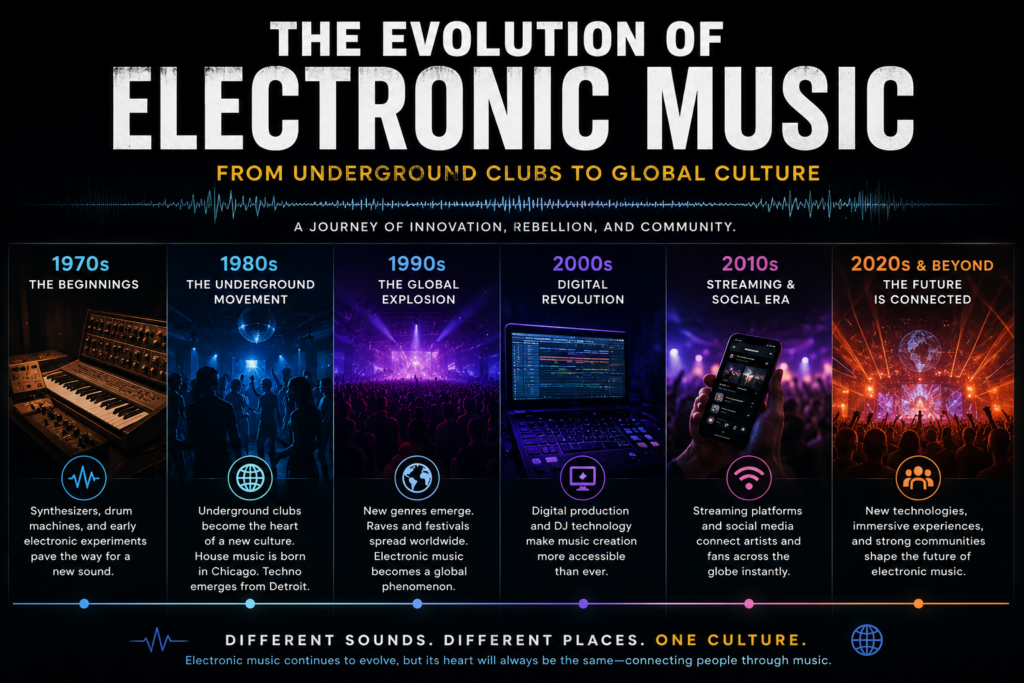
Electronic music genres can feel like a maze if you’re just getting started. Walk into any conversation about the scene and you’ll hear a dozen genre names thrown around like everyone’s supposed to already know the difference between techno and trance, or why drum & bass and dubstep both come from the UK but sound nothing alike. If you’ve ever nodded along at a festival lineup announcement without actually knowing what you were nodding at, this guide is for you.
Electronic music isn’t one thing. It’s a sprawling family tree that started in warehouses, basements, and bedroom studios across Chicago, Detroit, Berlin, and London, and it’s been branching ever since. Here’s a tour through the genres that matter most, what makes each one tick, and where to start listening.
House
Origin: Chicago, early 1980s Tempo: ~120–130 BPM
House is where a lot of modern electronic music begins. Born in Chicago clubs like the Warehouse (the genre’s namesake), house took disco’s four-on-the-floor beat and stripped it down with drum machines, basslines, and soulful vocal samples. It’s built for dancing — steady, repetitive, and hypnotic in the best way.
From there it splintered into dozens of subgenres: deep house (warmer, jazzier, more atmospheric), tech house (house crossed with techno’s grittier edge), progressive house (longer builds, bigger emotional payoffs), and future house (glossier, festival-ready production). If you’ve heard a “drop” at a big room set, you’ve probably heard house’s DNA at work even if the track itself has evolved far past its Chicago roots.
Start with: Frankie Knuckles, Larry Heard (Mr. Fingers), Disclosure, Fisher
Techno
Origin: Detroit, mid-to-late 1980s Tempo: ~120–150 BPM
If house has soul, techno has machinery. Detroit techno pioneers — often called the Belleville Three (Juan Atkins, Derrick May, Kevin Saunderson) — took influence from Kraftwerk and funk and built something colder, more futuristic, and more mechanical. Techno leans into repetition and texture over melody and vocals; it’s music about rhythm and atmosphere first.
Techno found a second home in Berlin after the fall of the Wall, where clubs like Berghain turned it into a near-religious experience — dark rooms, minimal lighting, hours-long sets. Minimal techno strips things down even further; industrial techno and hard techno push tempo and aggression up; melodic techno (think Tale Of Us, Artbat) reintroduces emotional, cinematic elements without losing the genre’s hypnotic pulse.
Start with: Jeff Mills, Ben Klock, Charlotte de Witte, Amelie Lens
Trance
Origin: Germany, early 1990s Tempo: ~130–150 BPM
Among electronic music genres, trance is the one built entirely around the emotional peak — the moment the breakdown ends, the kick drum comes back in, and a stadium’s worth of people throw their hands up at once. It grew out of techno and house but prioritized melody, key changes, and euphoric buildups over pure rhythm.
Uplifting trance and progressive trance are the big-tent, festival-mainstage version most people know from artists like Armin van Buuren and Above & Beyond. Psytrance, a very different branch that developed in Goa, India, is faster, weirder, and more psychedelic, built for all-night outdoor parties rather than arena stages.
Start with: Armin van Buuren, Above & Beyond, Ferry Corsten
Drum & Bass (DnB)
Origin: United Kingdom, early-to-mid 1990s Tempo: ~160–180 BPM
Drum & bass, one of the fastest electronic music genres on this list, came out of the UK’s jungle scene, itself a product of rave culture, reggae sound systems, and breakbeat sampling. The signature sound is fast, chopped-up breakbeats paired with deep, heavy sub-bass — a combination that sounds frantic and weighty at the same time.
Liquid drum & bass is the melodic, smoother end of the spectrum — often built around soulful vocals and jazzy chords. Neurofunk goes the opposite direction: dark, technical, aggressive basslines built for peak-time chaos. Jungle, the genre’s ancestor, still exists as its own lane, prized for its raw breakbeat energy and reggae/dancehall influence.
Start with: Goldie, LTJ Bukem, Netsky, Sub Focus
Dubstep
Origin: South London, early 2000s Tempo: ~140 BPM (with a half-time feel)
Dubstep, one of the moodier electronic music genres on this list, grew out of the UK garage scene and took its name seriously — it’s steeped in dub reggae’s love of bass and space. Early dubstep (Skream, Benga, Burial) was moody, sparse, and bass-heavy, built for headphones as much as clubs.
The genre split hard around 2010 when American producers picked it up and pushed it toward aggressive, distorted “brostep” — the wobbling, screeching bass drops most casual listeners associate with the word “dubstep” (think early Skrillex). Both lineages still coexist: the original UK sound remains dark and minimal, while the festival-mainstage version leans maximalist and high-energy.
Start with: Skream, Burial (for the UK original sound), Excision, Skrillex (for the heavier American strain)
Ambient
Origin: UK, late 1970s (with roots stretching back further) Tempo: often no fixed beat at all
Ambient is electronic music at its most patient. Brian Eno essentially named and defined the genre with Music for Airports (1978), describing it as music that should be “as ignorable as it is interesting” — background and foreground at once. There’s rarely a beat to dance to; instead, it’s about texture, drone, and slowly evolving soundscapes.
Ambient overlaps heavily with downtempo and chillout, genres built for the moments after (or between) dancing — the sunrise set, the chill-out room, the late-night wind-down.
Start with: Brian Eno, Aphex Twin (Selected Ambient Works), Boards of Canada
UK Garage
Origin: United Kingdom, early-to-mid 1990s Tempo: ~130–140 BPM
UK garage, a genre that sits at the crossroads of several electronic music genres, took Chicago and New York house music and ran it through a distinctly British filter — syncopated, shuffling rhythms, pitched-up vocal chops, and a swung, off-kilter groove that’s instantly recognizable. It was the sound of UK clubs in the late ’90s and directly influenced both grime and dubstep, making it something of a genetic hub for British electronic music.
2-step garage (the bouncier, more syncopated strain) is the version most associated with the genre’s golden era; the sound has seen a major resurgence in the 2020s alongside a broader UK dance music revival.
Start with: Artful Dodger, MJ Cole, Disclosure (early material)
Hardstyle & Hardcore
Origin: Netherlands/Germany, 1990s Tempo: ~150–180+ BPM
For listeners who want maximum intensity, these electronic music genres deliver more than most. This branch of the family delivers. Hardstyle combines distorted, punchy kick drums with euphoric melodic elements, big in the Netherlands and Belgium’s festival scenes. Hardcore (and its faster cousins gabber and speedcore) pushes tempo and aggression even further, built for a very specific, very committed audience.
Start with: Headhunterz, Angerfist
Synthwave
Origin: Internet-born, 2000s–2010s (drawing on 1980s film scores and synth-pop) Tempo: ~80–120 BPM
Synthwave, unlike most electronic music genres on this list, isn’t a club genre in the traditional sense — it’s a nostalgia project, built by producers obsessed with the analog synth sounds of 1980s movies, video games, and synth-pop. Think neon grids, retro album art, and basslines that sound like they belong in a John Carpenter film. It’s less about the dancefloor and more about mood and aesthetic, which is part of why it found such a strong home on YouTube and streaming rather than in clubs.
Start with: Kavinsky, Perturbator, The Midnight
Where Do You Start With Electronic Music Genres?
If all of this feels like a lot, here’s the honest shortcut: pick one genre that matches an energy you already like. Want something you could put on at a dinner party? Try deep house or downtempo. Want something to run to? Drum & bass or hardstyle. Want the “I want to cry on a dancefloor at 4am” experience? Trance or melodic techno. And if you’re ready to go from listener to selector, our guide to starting DJing is a solid next step.
Electronic music rewards curiosity more than almost any other genre family — because it’s not really one family, it’s dozens of them, constantly cross-pollinating. When it comes to electronic music genres, the best way in isn’t to master the family tree first. It’s to follow one track you like down whatever rabbit hole it leads to.
FAQs
What’s the difference between house and techno?
House tends to be warmer and more soulful, often built around samples, vocals, and a funkier groove. Techno is colder and more mechanical, prioritizing repetition, texture, and atmosphere over melody. Both share the same four-on-the-floor beat, but they feel very different on a dancefloor.
What is EDM, and is it the same as electronic music?
“EDM” (Electronic Dance Music) is technically an umbrella term, but in common usage it refers specifically to the festival-mainstage sound that emerged in the US in the 2010s — big drops, high energy, broad appeal. Electronic music is the much larger umbrella that includes everything from ambient to hardcore; EDM is just one commercial slice of it.
What’s the easiest genre to get into if I’m new to electronic music?
Deep house and melodic techno are good entry points — steady, groove-driven, and not too extreme in tempo or intensity. If you prefer something with more obvious hooks and energy, progressive house or uplifting trance are more immediately accessible.
Why do drum & bass and dubstep sound so different if they’re both from the UK?
They evolved from different lineages within the same rave continuum. Drum & bass grew out of jungle and breakbeat culture, prioritizing fast, chopped-up rhythms. Dubstep grew out of UK garage and dub reggae, prioritizing space, sub-bass, and a slower, half-time feel. Same city, same era, different sonic ancestors.
What’s the fastest electronic music genre?
Hardcore and its offshoots (gabber, speedcore) can run well past 180 BPM, sometimes into the 200s. Drum & bass typically sits around 160–180 BPM, making it one of the faster genres most people actually encounter regularly.
Is dubstep still popular?
Yes, though it’s split into distinct camps. The original UK sound (dark, minimal, bass-focused) has a dedicated underground following, while the heavier “brostep” style still fills festival stages, particularly in North America.
Do I need expensive equipment to start producing electronic music?
No. Most producers today start with a laptop and a DAW (Digital Audio Workstation) like Ableton Live, FL Studio, or Logic Pro, plus free or affordable plugins. Many iconic tracks in genres like techno and dubstep were made on modest home setups.
What genre should I listen to for studying or working?
Ambient and downtempo are built for exactly that — steady, non-intrusive, low on vocals and abrupt drops. Some minimal or dub techno also works well if you want a bit more rhythm in the background.