Electronic music trends never really settle — change is the genre’s default state, not an occasional event. Unlike a sound built around a fixed instrument, electronic music is built around tools that keep changing, generations that keep reacting against each other, and a global culture that keeps feeding new ingredients back into the mix. Here’s what’s actually driving the electronic music trends worth paying attention to right now.
Why Electronic Music Trends Never Stop
Unlike a genre built around a fixed instrument — a violin sounds like a violin in any decade — electronic music is built around tools that keep changing, so the genre itself has never had the option of standing still. Electronic music trends aren’t occasional blips; constant change is baked into how the culture works, since every new piece of gear, every new production technique, and every new generation looking to differentiate itself from the last pushes the sound somewhere new.
New Tools Keep Rewriting the Rules
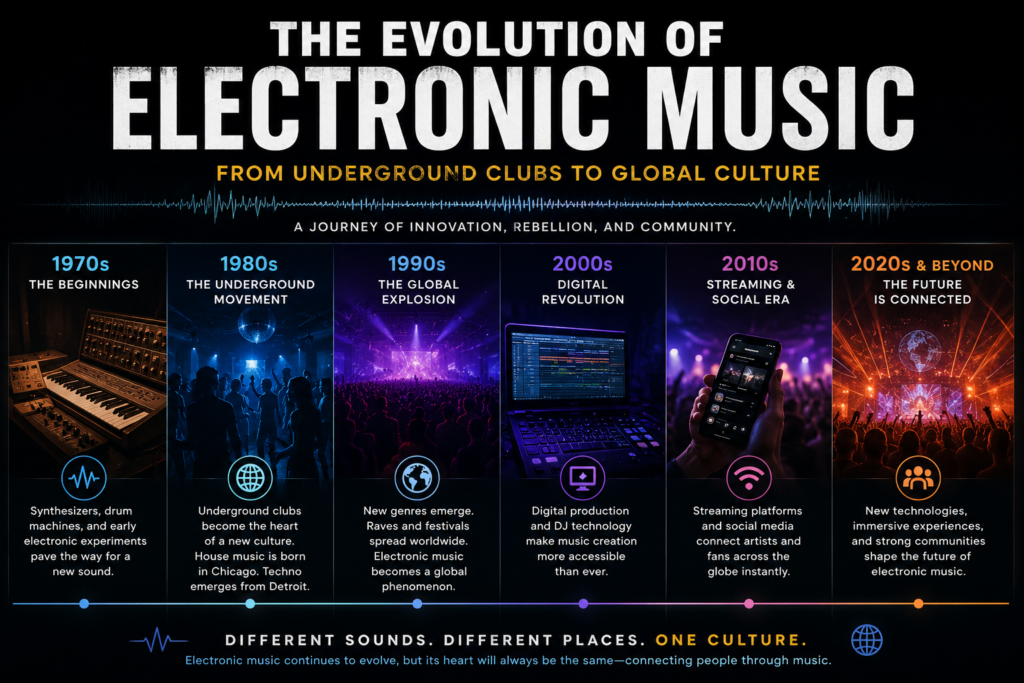
Trace the timeline and almost every major shift lines up with a new piece of technology becoming cheap enough for regular people to get their hands on: the Roland TR-808 and TB-303 — both originally commercial flops — built house and acid house once producers started misusing them; affordable samplers built jungle and the entire sample-based wing of the culture; and the shift to laptop production and DAWs in the 2000s let a single bedroom producer do what used to require a full studio and a record label’s budget. Each leap in tools didn’t just make existing music easier to make — it made entirely new kinds of music possible for the first time.
Every Generation Reacts Against the One Before It
A lot of what drives electronic music trends is generational friction. Techno’s original Detroit sound was itself partly a reaction to disco’s commercial collapse and the sterility of mainstream pop radio; the harder, more industrial techno of the early 90s was partly a reaction to acid house’s colorful optimism; and today’s minimal, stripped-back house and techno revivalists are, in part, a reaction against the maximalist, drop-heavy sound of 2010s festival EDM. Each generation of producers grows up steeped in one sound and spends their career pushing away from it, which is a reliable engine for constant change even without any new technology at all.
Globalization Keeps Adding New Ingredients
As electronic music spread beyond its original US and European hubs, it picked up new regional flavors that fed back into the global sound: Goa trance absorbed Indian psychedelic and spiritual influences; Brazilian and South African producers built entirely distinct strains of house — baile funk, amapiano — with their own rhythmic DNA; and Japanese and Southeast Asian scenes have pushed both ambient and hard dance traditions in directions Western producers hadn’t tried. None of these movements happened in isolation — they get sampled, remixed, and absorbed back into the mainstream conversation within a few years of emerging.
Streaming and Social Platforms Accelerate the Cycle
What used to take a decade to spread from a specific city’s clubs to the rest of the world now takes months, sometimes weeks. A sound that catches on in a short-form video can end up shaping what producers everywhere are making within a single release cycle, which means electronic music trends now move faster — and get documented in more real time — than at any previous point in history. It also means trends can burn out faster; a micro-sound can peak and get declared “over” within a year, in a way that took house or techno the better part of a decade to go through.
What’s Actually New Right Now
Right now, that constant-evolution engine is running on a mix of AI-assisted production tools lowering the technical floor even further, a wave of interest in slower, more organic-sounding hybrid genres as a reaction to years of maximalist festival sound, and continued cross-pollination between electronic production and genres like Afrobeats, amapiano, and Latin club music. None of that is the final word on these electronic music trends — by the time any of it gets written down, the next reaction against it is probably already forming in someone’s bedroom studio.
If you want the vocabulary for where things stand today, our electronic music genres explained guide and our piece on underground electronic music both cover ground this piece builds on.
Frequently Asked Questions
Quick answers to the questions this piece raises most often.
Why does electronic music change so fast compared to other genres?
Because it’s built entirely on tools — synthesizers, drum machines, software — that keep getting cheaper and more capable, so the genre’s raw materials are constantly changing, unlike a genre built around a fixed acoustic instrument.
What technology has had the biggest impact on electronic music’s evolution?
Affordable drum machines and samplers in the 1980s (like the Roland TR-808 and TB-303) and the shift to laptop-based production in the 2000s are usually cited as the two biggest turning points, each opening the genre to a much wider group of producers.
Is the current wave of electronic music trends driven more by technology or culture?
Both, constantly feeding each other. New tools make new sounds possible, and cultural reactions — a generation pushing back against the sound that came before it — decide which of those new sounds actually stick.
How has streaming changed how quickly electronic music evolves?
It’s compressed the timeline dramatically. Sounds that once took years to spread from a local scene to a global audience can now spread in weeks through short-form video and playlist algorithms, speeding up both the rise and the burnout of new micro-trends.
Are AI tools changing how electronic music is made?
Increasingly, yes — AI-assisted production tools are lowering the technical barrier to making finished-sounding tracks even further, which is likely to keep accelerating the pace of new subgenres and hybrid styles.
Does electronic music’s constant change mean older styles disappear?
Not usually. Older styles tend to persist in smaller, dedicated scenes even after the mainstream conversation moves on, and many eventually come back around as a new generation rediscovers and reinterprets them.
What role does globalization play in today’s electronic music trends?
A major one. As the genre spread beyond its original US and European hubs, regional scenes in places like Brazil, South Africa, and India fed distinct rhythmic and melodic ideas back into the wider culture, rather than just adopting an existing template.
What’s likely to shape electronic music’s next phase?
Continued cross-pollination with genres like Afrobeats and amapiano, AI-assisted production tools, and — if the pattern holds — a generational reaction against whatever sound currently dominates festival main stages.
By The DJs. For The DJs.
Subcultural Music — subculturalmusic.com