Electronic music has always been about more than music.
For many people, it begins with a track, a playlist, or a late-night DJ set. But what keeps them coming back isn’t just the sound—it’s the people. It’s the feeling of standing on a dance floor surrounded by strangers who somehow share the same rhythm, the same energy, and the same reason for being there.
Unlike many other genres, electronic music has never relied on a single superstar or a fixed way of experiencing it. Its strength lies in the communities it creates. Around the world, countless clubs, collectives, festivals, independent labels, and local promoters have built spaces where music becomes a shared experience rather than simply entertainment.
Today, electronic music connects millions of people across countries, cultures, and languages. Here’s how it became one of the world’s most community-driven movements.
The Birth of a Movement
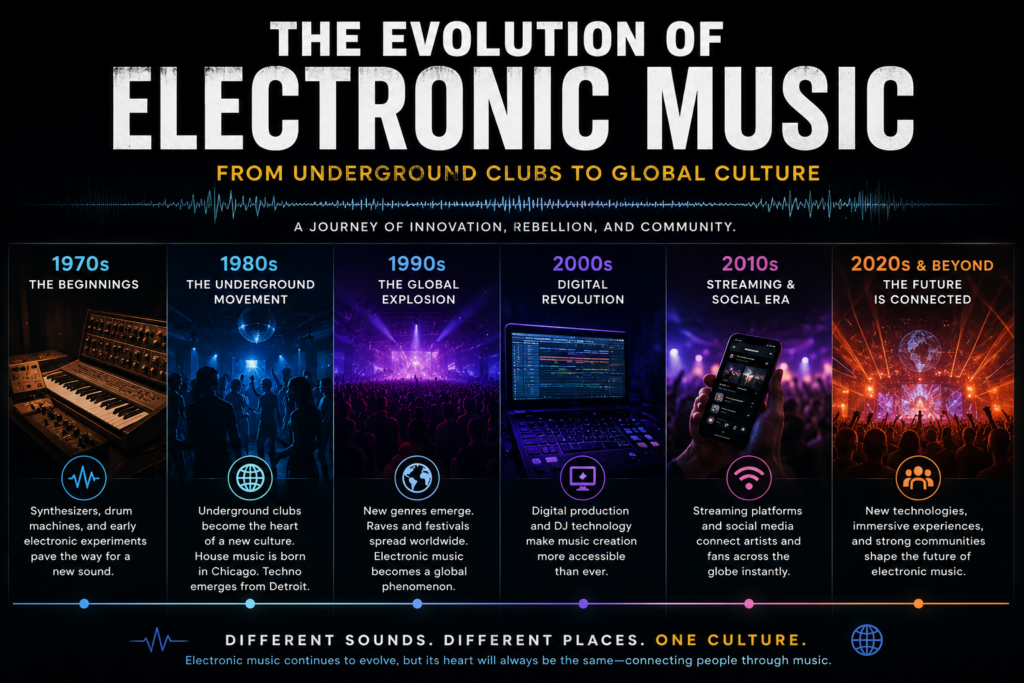
The story of electronic music isn’t just about synthesizers and drum machines—it’s about people creating spaces where they could belong.
In cities like Chicago, Detroit, and New York, underground clubs became safe places for communities that often felt excluded from mainstream culture. DJs experimented with new sounds, producers pushed creative boundaries, and dancers gathered not because of celebrity lineups, but because of the atmosphere.
The dance floor became a place where background, profession, age, and social status mattered less than the music playing through the speakers.
That sense of togetherness became the foundation of electronic music culture.
The Dance Floor as a Community Space
Unlike a traditional concert, where the audience faces a stage and watches an artist perform, electronic music creates a different relationship between artist and audience.
The DJ guides the room, but the crowd shapes the experience.
Every reaction influences the next track. Every moment on the dance floor becomes part of a conversation between the people behind the booth and the people in front of it.
This interaction creates something unique: a room full of individuals becoming a single community for a few hours.
That’s why so many people describe electronic music events as experiences rather than performances.
Music Beyond Language
One of electronic music’s greatest strengths is that it rarely depends on lyrics.
Instead, it communicates through rhythm, melody, texture, and emotion.
Because of this, people from completely different cultures can connect through the same track without sharing a common language.
Whether you’re in Berlin, Delhi, São Paulo, Tokyo, Cape Town, or London, the feeling of hearing a familiar groove on a dance floor remains remarkably similar.
Music becomes the universal language.
Independent Collectives Changed Everything
While festivals and famous clubs often receive the spotlight, much of electronic music’s growth has come from independent communities.
Across the world, small collectives began organizing intimate events in warehouses, cafés, rooftops, studios, art galleries, and unconventional venues.
These weren’t built around celebrity headliners.
They were built around shared values:
- Supporting local artists
- Introducing new sounds
- Creating inclusive spaces
- Encouraging creativity
- Building genuine friendships
- Growing local music culture
Many of today’s respected artists began performing at events organized by passionate local communities long before reaching international audiences.
Clubs Became Cultural Hubs
Great clubs have never been just places to dance.
They’ve acted as meeting points for musicians, designers, photographers, filmmakers, visual artists, promoters, and creative thinkers.
Conversations started on dance floors often evolve into collaborations, friendships, businesses, and entirely new creative projects.
Some of the world’s most influential music scenes grew because clubs became cultural hubs rather than simply nightlife venues.
Festivals Created Global Communities
As electronic music expanded, festivals introduced people to artists and genres from across the world.
Today, someone might discover a DJ from South Africa, a producer from Japan, a vocalist from Brazil, and a label from Germany—all during the same weekend.
Festivals also encourage cultural exchange.
People travel thousands of miles, meet new friends, share recommendations, and often leave feeling connected to communities far beyond their own city.
The Internet Connected the Underground
Long before social media algorithms dominated music discovery, online forums, blogs, internet radio stations, and independent websites helped electronic music spread globally.
Today, discovery happens through:
- Streaming platforms
- YouTube DJ sets
- Independent radio shows
- Podcasts
- Discord communities
- Reddit discussions
- Instagram creators
- Online record stores
Someone in India can instantly discover a producer from Argentina or attend a livestream from Amsterdam.
Geography is no longer a barrier.
Local Communities Still Matter Most
Even with global access, local communities remain the heartbeat of electronic music.
Small events often offer something large festivals can’t:
- Personal connections
- Intimate venues
- New artists
- Creative freedom
- A stronger sense of belonging
Many lifelong friendships begin at local events where people return week after week, gradually becoming familiar faces.
These communities are where artists grow, ideas are tested, and local scenes develop their own identity.
Why Inclusivity Is Central to Electronic Music
Electronic music has long promoted the idea that everyone deserves a place on the dance floor.
The strongest communities encourage:
- Respect for others
- Diversity of backgrounds
- Freedom of expression
- Safe environments
- Shared experiences
- Mutual support
When people feel welcome, they’re more likely to return, contribute, and help grow the community.
That’s how scenes remain healthy over time.
The Role of Independent Labels
Record labels do more than release music.
Independent labels often introduce new artists, organize showcases, build creative identities, and connect musicians from different countries.
Many labels eventually become communities themselves, with loyal listeners following not just individual artists but the label’s overall sound and vision.
Why Community Matters More Than Ever
Modern life is increasingly digital.
People spend more time behind screens and less time meeting face to face.
Electronic music offers something different.
It encourages people to leave their homes, discover new places, dance with strangers, and create memories that exist beyond notifications and timelines.
For many, that’s become one of its greatest strengths.
Building Communities Through Music
Around the world, independent music collectives continue to prove that meaningful communities don’t require massive budgets or celebrity lineups.
They require intention.
When events prioritize music, respect, creativity, and connection, people return not just for the artists but for the atmosphere they’ve become part of.
The strongest communities aren’t built overnight.
They’re built one event, one conversation, and one shared experience at a time.
Final Thoughts
Electronic music has never simply been about technology or dance floors.
It’s about creating spaces where people can connect through sound, creativity, and shared experiences.
From underground clubs and independent collectives to international festivals and online communities, electronic music has shown that culture grows strongest when people come together around something they genuinely love.
Long after the final track fades, it’s often the friendships, conversations, and sense of belonging that people remember most.
That’s what makes electronic music more than a genre.
It’s a community.
Join the Community
If you’re passionate about electronic music and want to discover curated events, artist broadcasts, and stories from the underground scene, Subcultural Music is building a community where music, culture, and connection come together.
Explore our latest broadcasts, read more stories from the world of electronic music, and join us at our next event.
Music • Culture • Community
FAQs