Dance music has never stood still. What started as a rebellious, underground reaction to disco’s decline in the early 1980s has grown into one of the most influential musical movements of the last half-century — reshaping clubs, festivals, technology, and entire cities along the way. The evolution of dance music isn’t a straight line; it’s a constant cycle of underground scenes going mainstream, then splintering into new sounds that start the cycle again.
Here’s how dance music has transformed over the last 40 years — decade by decade — and where it’s headed next.
The 1980s: Disco’s Underground Rebirth
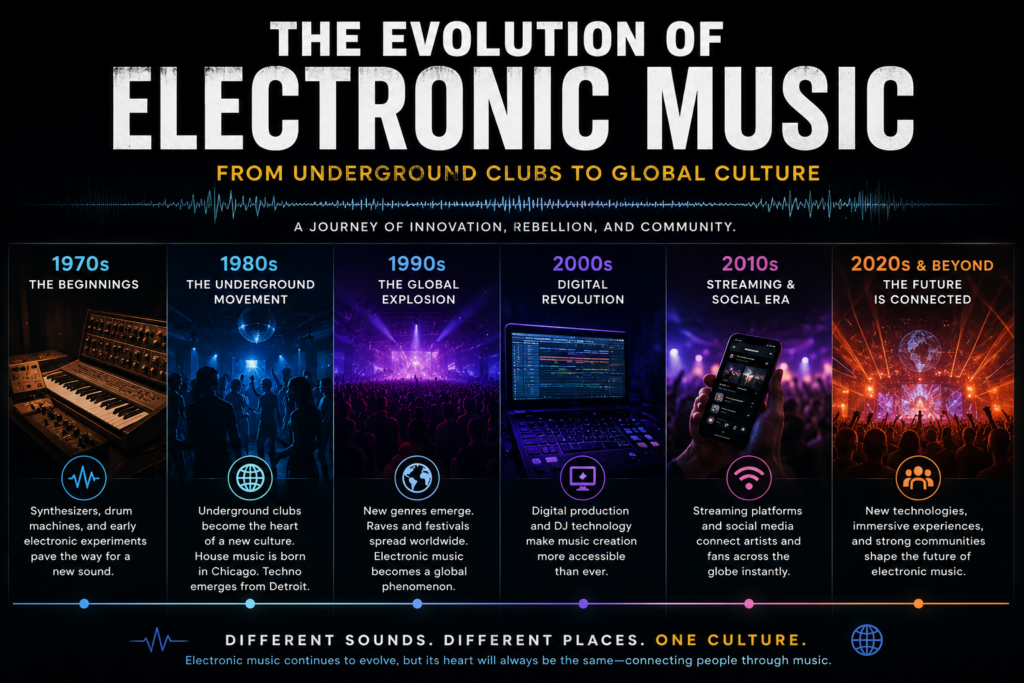
When disco collapsed commercially in the US at the end of the 1970s, its DNA didn’t disappear — it went underground and mutated into something new. In Chicago, DJs like Frankie Knuckles were reworking disco records at clubs like the Warehouse, slowing them down, looping the drum breaks, and layering in drum machines. That sound earned a name from the club that birthed it: house music.
At the same time, in Detroit, three friends known as the Belleville Three — Juan Atkins, Derrick May, and Kevin Saunderson — were fusing funk, European electronic music, and science-fiction futurism into something starker and more mechanical: techno. Derrick May’s 1987 track “Strings of Life” became one of the genre’s defining anthems.
None of this would have sounded the way it did without new, affordable hardware. The Roland TR-808 and TR-909 drum machines and the TB-303 bass synthesizer — originally considered commercial flops — became the backbone of house and techno’s signature sound, proving that dance music’s evolution has always been tied as much to technology as to culture.
The 1990s: Rave Culture Goes Global
By the late 1980s, house and acid house had crossed the Atlantic and ignited the UK’s “Second Summer of Love” — a explosion of illegal warehouse parties and open-field raves that turned dance music into a full-blown youth movement. The 1990s took that energy and ran with it globally.
This is the decade dance music truly fragmented into genres. The UK gave rise to jungle and drum & bass, built on breakbeats sped up to frantic tempos. Trance emerged in Germany and the Netherlands, built around soaring melodies and hypnotic builds. UK garage brought a swung, bass-heavy groove that would later influence entire generations of UK producers. Meanwhile, rave culture — and the massive superclubs and free parties that came with it — turned dance music from a niche subculture into a genuine global phenomenon, a pivotal chapter in the evolution of dance music.
The 2000s: Dance Music Finds Its Mainstream Footing
The 2000s were about dance music professionalizing and going mainstream — carefully at first, then all at once. In France, Daft Punk and the “French touch” scene fused house with disco samples and filtered basslines, influencing pop production far beyond dance floors. Trance had its commercial peak, filling arenas with acts like Tiësto and Armin van Buuren. Electro house began creeping into mainstream radio, marking another key turning point in the evolution of dance music.
Just as important: this was the decade dance music got its stages. Tomorrowland launched in Belgium in 2005; Ultra Music Festival and EDC were scaling up in the US. The festival, rather than the club, was becoming dance music’s biggest stage — setting up the explosion that was about to happen.
The 2010s: The EDM Boom
If the 2000s built the stage, the 2010s filled the stadium. “EDM” became a mainstream cultural label, and dance music crossed fully into pop. Artists like Skrillex, Avicii, Calvin Harris, and David Guetta brought dance production into Top 40 radio, while festivals like Tomorrowland and EDC grew into multi-day, multi-continent spectacles drawing hundreds of thousands of attendees — the clearest sign yet of the evolution of dance music from subculture to global industry.
Dubstep — born in the UK’s bass music underground — exploded into a heavier, more aggressive mainstream sound. Streaming platforms reshaped how dance music was discovered and consumed, collapsing the old gatekeeping of radio and record stores. By the end of the decade, dance music wasn’t a subculture anymore — it was a global industry.
The 2020s: Fusion, Revival, and a New Global Sound
After a pandemic-driven pause, dance music has come back louder, more diverse, and more genre-fluid than ever. The defining story of the mid-2020s is the explosive global rise of Afro house and amapiano — genres built on hypnotic log-drum basslines and jazz-influenced pads that originated in South Africa. Afro house has been named among the defining sounds of the decade, with festivals like Tomorrowland adding dedicated stages for it in 2026 and download growth well over 700% in a single year, according to Beatportal’s year-end analysis.
Alongside that, progressive house is having one of its strongest revivals in years, melodic techno continues to grow, and UK garage is finding a new generation of fans. Genre boundaries are dissolving faster than ever — a single festival lineup today might move from Afro house to melodic techno to hyperpop-influenced dance-pop without missing a beat. And crucially, dance music’s growth is no longer centered on the US and Western Europe alone — scenes in India, across Africa, and throughout Southeast Asia are now shaping global sound rather than just following it.
Where Dance Music Goes Next
Forty years on from its underground beginnings, dance music’s throughline has stayed the same even as the sounds keep changing: it’s music built for community, made by people pushing new technology and new ideas onto the dance floor. Whether that’s a warehouse party in 1980s Chicago or a curated club night today, the evolution of dance music has always been driven by the same thing — people showing up to move together. At Subcultural Music, we’re proud to be part of that story, championing the artists shaping the next evolution of dance music.
FAQs
What started the evolution of dance music?
Dance music’s modern evolution began in the early 1980s when disco’s underground DNA merged with new electronic instruments in Chicago and Detroit, giving birth to house and techno.
What’s the difference between house and techno?
House music, born in Chicago, is generally warmer and groove-driven, often built on disco and soul samples. Techno, born in Detroit, tends to be starker, more mechanical, and futuristic in its sound design. Both share a 4/4 beat and emerged around the same time.
Why did EDM become mainstream in the 2010s?
A combination of festival culture scaling up, dance producers crossing over into pop radio (Skrillex, Avicii, Guetta), and streaming platforms making dance music instantly accessible pushed EDM into the mainstream during the 2010s.
What are the biggest dance music trends right now?
Afro house and amapiano are currently the fastest-growing sounds in dance music globally, alongside a strong revival of progressive house and melodic techno.
How can I discover dance music events near me?
Follow independent collectives, local venues, and community platforms like Subcultural Music, which regularly showcase emerging dance music through curated events, broadcasts, and cultural experiences.