
Somewhere between the crate and the crowd, a good set becomes a great one. Here’s what actually separates the two.
Warm-Up
Ask anyone who’s stood in front of a rig at 4 a.m. what made that particular electronic music set great, and you’ll rarely get an answer about the track list. They’ll talk about a moment — the way a kick dropped back in after a long breakdown, the second the whole room seemed to inhale at once, a track they’d never heard before that somehow felt inevitable. A great set isn’t assembled beforehand and pressed play. It’s built, track by track, in real time, in a specific room, with a specific crowd, and it can only happen once.
That’s the paradox at the center of electronic music’s most basic unit of performance. Two DJs can play largely the same records in the same order and produce entirely different nights. The difference isn’t in the crate. It’s in everything that happens around it — the reading, the risk-taking, the restraint. That’s the difference between a forgettable electronic music set and one people still talk about years later.
Selection
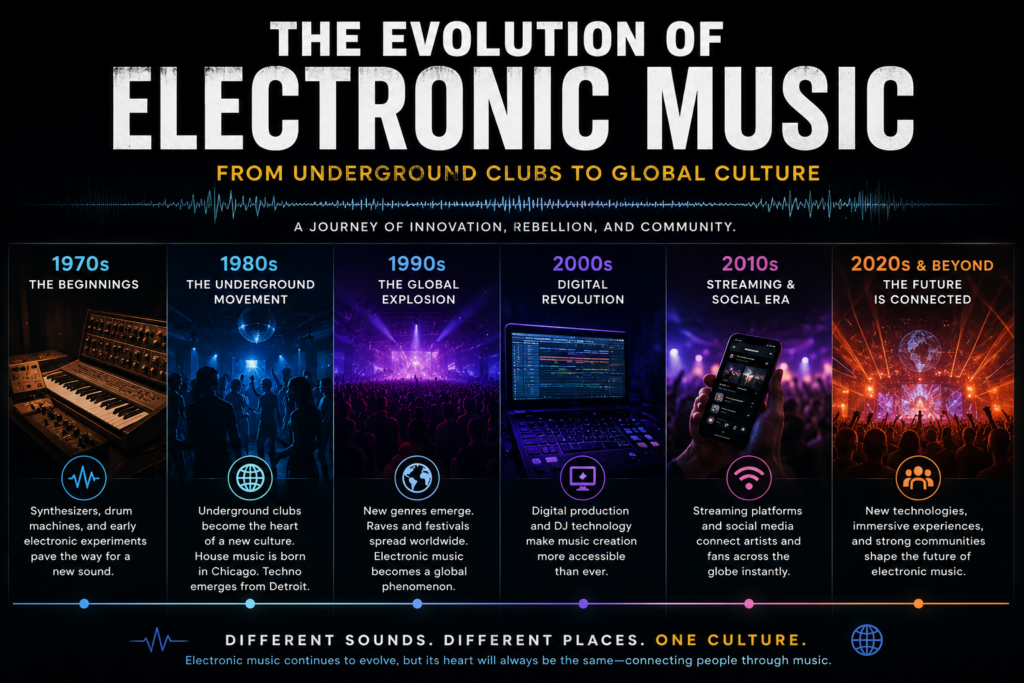
Every great DJ set starts with digging, and digging is where a lot of the culture’s actual values live. House and techno both trace back to specific rooms — Chicago warehouses in the early 1980s, where DJs like Frankie Knuckles were stretching disco into something rawer and more mechanical for crowds the mainstream had no interest in serving. (If you want the fuller family tree, our electronic music genres guide breaks down how house, techno, and their descendants split off from there.) That lineage matters to the culture in a very literal way: knowing it, and knowing the labels, edits, and lesser-known producers carrying it forward today, is still one of the clearest markers of who’s actually in the scene versus who just showed up for the headliner.
That’s not gatekeeping for its own sake. A DJ who has spent years digging — through record shops, Bandcamp pages, other people’s sets, unreleased IDs traded in DMs — builds a vocabulary that a Top 50 chart simply doesn’t contain. The selection itself becomes the argument: this is what I think is worth your attention tonight, assembled from records almost nobody else in the room will already know by name.
The Mix
Beatmatching two tracks in time is table stakes; it stopped being the impressive part of DJing around the time software started doing it automatically. What actually separates a technically competent set from a great one is phrasing — lining up not just the tempo of two records but their structure, so a breakdown meets a breakdown and a drop lands where the crowd’s body has already decided it should. It’s EQ work that lets a bassline hand off cleanly instead of colliding. It’s knowing when a blend should last four bars and when it should last four minutes. None of it registers to the crowd as technique — it just registers as a great electronic music set.
The best transitions are the ones nobody in the crowd could describe afterward, because the two tracks felt like they’d always belonged together.
None of that is meant to be noticed in a well-mixed electronic music set. The technique exists entirely in service of the feeling — the moment a DJ starts mixing to show off the technique instead, the set stops being about the room and starts being about the DJ.
The Room
A set doesn’t happen in a vacuum; it happens through a specific sound system, in a specific room, for a specific crowd, and all three are instruments the DJ is playing along with the music. A club-grade rig with real low end can make a stripped-back track feel enormous in a way that no bedroom setup ever will, which is part of why so much of the culture’s soul still lives in unglamorous rooms — basements, converted warehouses, spaces chosen for how they sound rather than how they photograph. Reading that room well is half of what makes an electronic music set work at all.
Reading the room starts before the first track of an electronic music set even plays. Crowd size, how people are standing, whether they’re already moving or waiting to be convinced — all of it shapes how quickly a DJ can build. Energy is contagious in group settings, so pushing too hard, too early, tends to overwhelm a room before it’s ready, while sitting on one tempo too long lets attention drift. The DJs who get this right treat the set as a conversation rather than a broadcast: they watch hands, heads, and the crowd drifting toward or away from the booth, and they let what they see change what they play next, not just what they planned in advance.
The Arc
A great electronic music set has an architecture, and it’s rarely a straight line. The instinct to keep climbing — bigger, harder, louder — burns a room out fast. What actually holds a night together is a series of waves: a build, a peak, a release, space to breathe, and then another build that lands harder because of the space that came before it. A breakdown in the middle of a set isn’t a lull; done well, it’s the thing that makes the next drop mean something.
That shape can’t be fully written in advance, which is why the best sets involve real improvisation — abandoning the planned next track because the room is asking for something else, or holding a peak an extra ten minutes because nobody’s ready to come down yet. The set becomes a feedback loop: the crowd’s energy shapes the DJ’s choices, and the DJ’s choices shape the crowd’s energy right back.
The Tension
None of this happens outside of history, and electronic music’s underground has always had an uneasy relationship with its own mainstream. House music’s earliest home was Black and queer nightlife in 1980s Chicago, organized around illegal gatherings that had nothing to do with an industry. The culture that grew out of those rooms carried an ethic often shorthanded as PLUR — peace, love, unity, respect — and a genuine skepticism toward anything that felt commercial.
Four decades later, that same music fills stadiums, with $400 festival tickets and celebrity residencies worth more than most people will earn in a lifetime. To a lot of scene veterans, that’s a betrayal of what the music was built on — proof that a subculture doesn’t survive contact with real money. Whatever side of that argument you land on, it’s still the same electronic music set format underneath — a DJ, a room, and a crowd.
Others, including artists who’ve lived through the whole arc, see it differently. Carl Cox has argued that mainstream festivals function as an entry point rather than an ending: someone who discovers electronic music through a headline set eventually goes looking for the DJs and labels behind it, and ends up in a basement club a couple of years later, holding a record they dug up themselves. Both things can be true at once, and the tension between them isn’t a problem the culture needs to solve so much as one it keeps arguing about, set by set, room by room.
The Drop
So what actually makes an electronic music set great? Not any one of these things alone — not the crate, not the technique, not the room, not the history. It’s a DJ who’s done the work of digging deep enough to have something worth playing, skilled enough that the mechanics disappear, and present enough in the room to abandon the plan the second the crowd asks for something else. It’s the willingness to play the unfamiliar track that might not land, because a set built entirely on sure things never becomes a great one.
The best sets end the same way they start: with a room full of strangers who, for a couple of hours, were having the same conversation at the same time. That’s not something a track list can guarantee. It’s something a DJ has to earn, one blend at a time.
Frequently Asked Questions
Quick answers to the questions this piece raises most often.
What’s the difference between a good DJ set and a great one?
A good electronic music set is technically solid and keeps people dancing. A great one does that and reads the room in real time, takes risks on unfamiliar tracks, and builds toward moments that couldn’t have happened with a different crowd on a different night.
Do DJs plan their sets in advance, or improvise?
Most DJs prepare — digging for tracks and roughing out an arc, sometimes prepping a few key transitions. But the best sets stay flexible: the planned tracklist is a starting point, not a script, and it’s expected to change once the DJ sees how the room is actually responding.
What does “reading the crowd” actually mean?
It means watching how people are moving, standing, and reacting — hands up or down, drifting toward the booth or away from it — and using that to decide what to play next. It starts before the first track and continues all night, treating the set as a two-way conversation rather than a fixed performance.
What’s an “ID” in a DJ set?
An ID is a track whose title and artist aren’t publicly known, often because it’s unreleased or unofficial. DJs and fans trade IDs like currency, and “ID – ID” is a common line in a tracklist when nobody can identify what was just played.
What does PLUR stand for?
Peace, Love, Unity, Respect. It’s an ethic that traces back to Chicago’s early house scene and New York’s rave scene in the 1980s and 90s, and it’s still referenced in rave culture today, including on the kandi bracelets traded at festivals.
Why do breakdowns matter in a set?
A breakdown gives the crowd space to breathe after a peak, which makes the next build land harder. Skilled DJs use breakdowns deliberately rather than treating them as a dip in energy — done well, they’re part of what makes the following drop feel earned.
Is beatmatching still an important skill if software can do it automatically?
It’s still a foundational skill, but it’s no longer what separates a good DJ from a great one — most modern software can keep two tracks in time. What matters more now is phrasing, track selection, and the judgment to know when and how to use a transition, not just whether it’s technically clean.
Why do some scene veterans dislike mainstream festival culture?
Electronic music’s underground grew out of DIY, often illegal gatherings with little connection to the music industry, and some longtime scene members see today’s corporate-sponsored festivals and celebrity DJ fees as a betrayal of that origin. Others argue mainstream exposure works as an entry point that eventually leads new fans toward the underground artists and labels the culture was built on.
If you want to go deeper on what a great electronic music set can pull from, our companion piece Understanding Electronic Music Genres: A Complete Guide breaks down the genres by name.
By The DJs. For The DJs.
Subcultural Music — subculturalmusic.com